


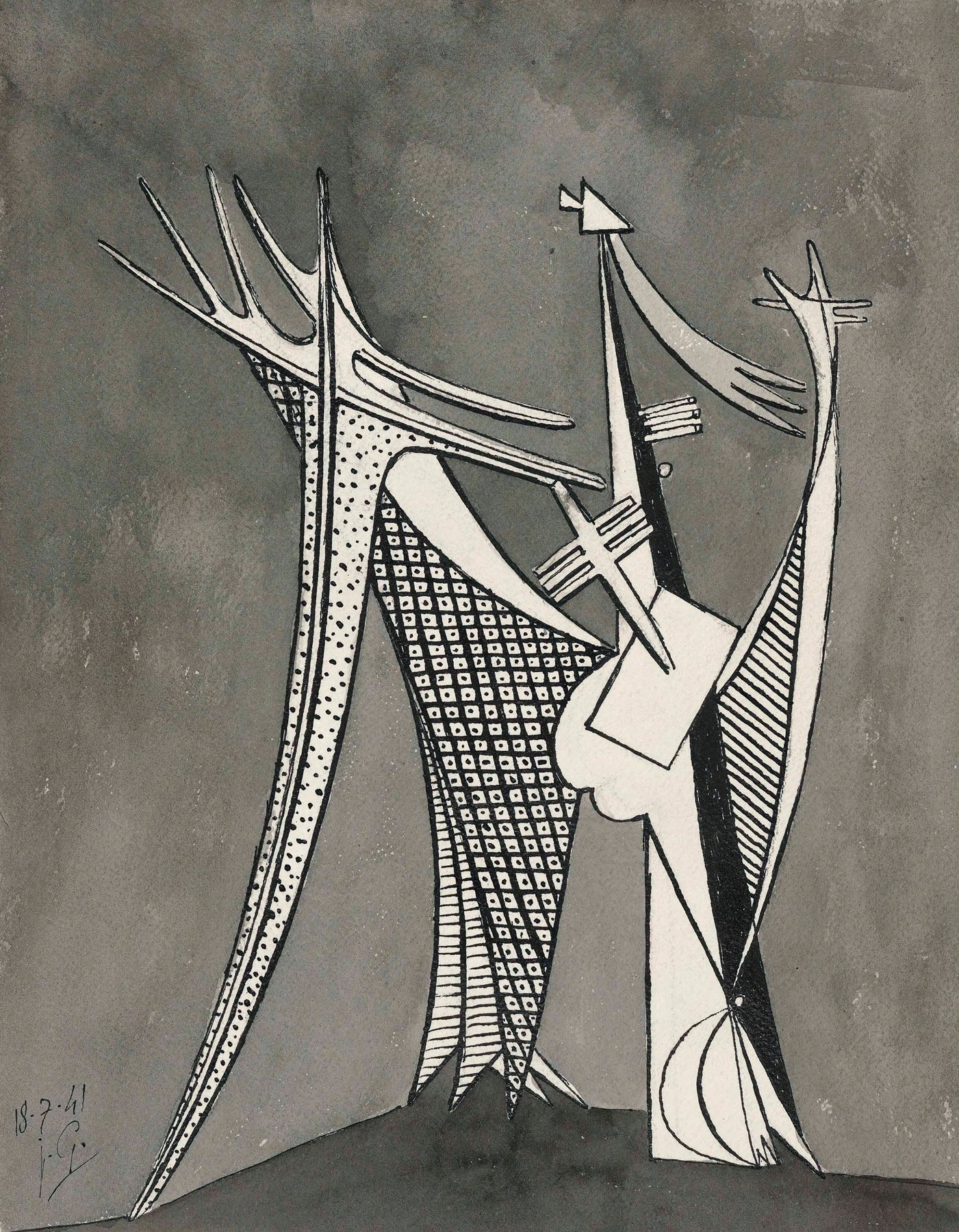
Abstrait (1941) by Julio González
North eastern Catalonia is an expensive place to have a flag habit. A place where a new bandera can be proud on Monday and gone by the weekend. Where the wind polishes and scours and beats hollow, turning new topsoil into smoke and fog.
You see it before you feel it: that threat of white cloud veiling peaks. Which means fair warning. Get ready. You are going to see flags decaying in real time. The Tramuntana is not a subtle wind.
Narrow streets become cauldrons of waltzing dust. Spring leaves turn into dust. You have something in your eye. You have dust in your eye. Even birds have a hard time.
Every physical object is a musical instrument. Chimney trombones. Cable cellos. Windowblind tambourines. You cannot escape the orchestra or the percussion. In the harbours at Portbou and Llança the whine from thousands of metres of rigging in hundreds of docked boats is a fearsome and mournful tremolo.
Catalans like to talk about The Tramuntana, and its quartet of door-slamming beats — Tra-mun-ta-na — is stressed by queue gossips in tones of grudging awe.
But sailors do not want to say its name and have superstitious routines to avoid other words they do not want to hear or say. Words like shipwreck and drowning.
The Tramuntana is not a noble wind. It is fickle and violent, travelling over crops and buildings in a sine wave, like a serpent. On Tramuntana days, children get sent out of classrooms for random acts of vandalism and teachers need paracetamol. But criminals love The Tramuntana. Burglars especially. The sound of breaking glass is camouflaged by the howl.
The Tramuntana will thrash your flag to nothing but dry your sheets during your coffee break.
Objects travel in ways they are not designed to travel: chairs, pots, smaller humans.
Cats are too smart to fly off walls but small dogs are at risk. Anything not fixed in concrete can take off. Sometimes concrete takes off.
Signposts frisbee over highways and terracotta roof tiles smash like biscuits in the lanes around the church. There are power cuts. Car doors break legs.
There is beauty on Tramuntana days when the sky is washed of all humidity. All the words for blue are good enough: cobalt, azure, cerulean, ultramarine. Stars later are tuned up, turned up. And there is something baby-like about the clarity of those horizons, even if you might want to wear a crash helmet near old trees. Even if your face is parched and your lips are burning.
Like a crazed festival, The Tramuntana can go for a week without pausing to inhale. Older people with scars tell you it used to last for weeks plural in the 1960s.
Yes, the Tramuntana makes some people lose their reason — perhaps because of sleeplessness — but they often lose it without regret. Here we are fated to lose our reason in this way.
Catalans moan about The Tramuntana, but the moaning often contains a type of gleeful patriotism. In a referendum I predict a majority would vote to keep The Tramuntana. Even with the wailing through every gap and the rheumatics, and the extra moisturiser costs.
Even though you have to push hard downhill and it brings headaches and sinus jams and bad dreams.
Technically, the Pyrenees and massif push cold dry air from the north, speeding the wind as it goes to the sea. But I think the true story is that we need to be reminded that being organised and sensible is only a human game you can play some of the time.
English people do not have names for winds. Wind is just wind. But at school here in Catalonia children copy diagrams showing the names of eight winds on compass points (llevant to the east, for example, or ponent to the west). You never hear people talking about those winds but you do hear a lot about the infamous northern brawler: The Tramuntana.
Charging mountains and eating fabric a centimetre per hour.
The Tramuntana has been blowing now for seven days.
Or is it seven years?
Or centuries?
My brain is too dry to think straight.
I just checked the data and the gustiest gust in this village this week was 126kmh (78mph). Which is mild for a wind known to top 200kmh (124mph).
But numbers mean nothing to The Tramuntana. Only the tease. Only the rush.
Usually I listen to a podcast, walking in the hills, but that is not possible with the melody and compression of The Tramuntana.
With sunglasses and good spatial awareness, you can still go outside, and you can hear those multiple pitches at the same time, and the swell in the long grass, and the distortion.
If The Tramuntana could be translated into human music it would become John Coltrane’s Meditations.
But tonight it is known only in its native language: branches down and bees escaped.
You are not allowed to sleep.
I love it! There's a lot of music in your piece! Have a beautiful day!
Beautiful